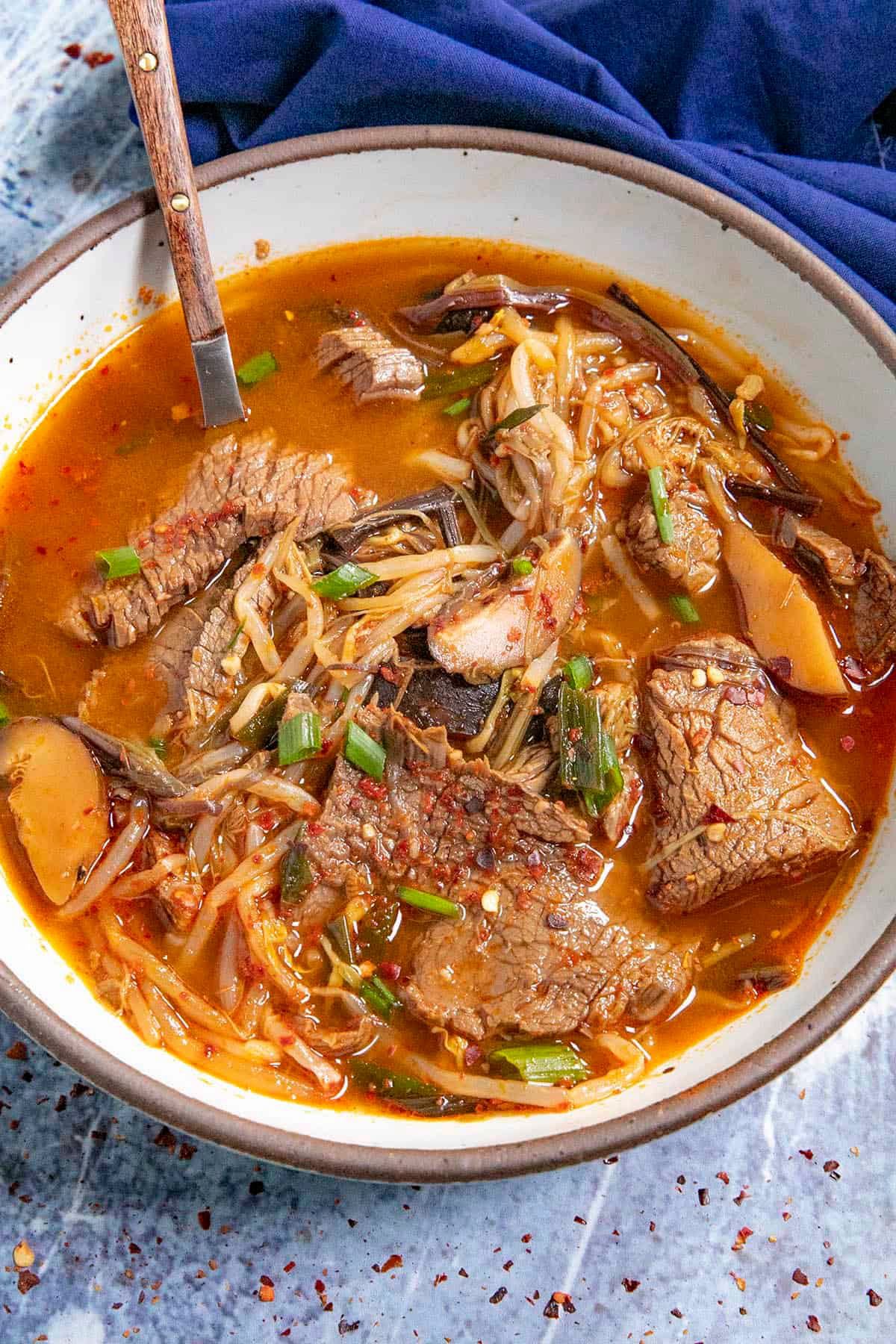
(Spicy Korean Beef & Vegetable Soup)
Yukgaejang is a bold Korean soup made with tender shredded beef, scallions, vegetables, garlic, and a deeply savory red chile broth. 🌶️🔥 It is warming, spicy, garlicky, and incredibly satisfying—especially served bubbling hot with a bowl of steamed rice.
Traditional versions vary by household, but beef, plenty of green onions, vegetables, and a chile-forward seasoned broth are at the heart of this comforting dish.
Full Recipe (Ingredients + Instructions)
Ingredients – Serves 6
For the Beef & Broth 🥩
- 1½ lbs beef brisket or beef chuck
- 10 cups water
- ½ large onion
- 6 garlic cloves, lightly crushed
- 2 scallions
- 1 teaspoon black peppercorns, optional
Vegetables 🌿
- 8–10 scallions
- 8 oz mung bean sprouts
- 6 oz Korean fernbrake (gosari), prepared and drained
- 6 oz oyster mushrooms or shiitake mushrooms
- 1 cup sliced Korean radish or daikon, optional
Spicy Seasoning 🌶️
- 3 tablespoons Korean red pepper flakes (gochugaru)
- 2 tablespoons sesame oil
- 1 tablespoon neutral oil
- 4 garlic cloves, minced
- 3 tablespoons soup soy sauce (guk-ganjang)
- 1 tablespoon regular soy sauce
- 1 tablespoon fish sauce, optional
- 1 teaspoon sugar
- ½ teaspoon freshly ground black pepper
For Finishing
- 2 large eggs, lightly beaten, optional
- Salt, to taste
- Additional gochugaru, to taste
- Steamed short-grain rice, for serving
Step 1: Cook the Beef 🥩
Place the beef in a large pot with the water, onion, garlic, scallions, and optional peppercorns.
Bring to a boil.
Skim away any foam that rises to the surface.
Reduce the heat, partially cover, and simmer gently for approximately 1½–2 hours, or until the beef is tender enough to shred.
Flavor Tip ❤️
Don’t aggressively boil the broth.
A gentle simmer gives you tender beef and a cleaner-tasting broth.
Step 2: Shred the Beef
Remove the cooked beef and let it cool enough to handle.
Shred it into long, bite-size pieces using your fingers or two forks.
Strain the broth and discard the cooked aromatics.
You should have approximately 7–8 cups of flavorful beef broth remaining.
If necessary, add a little water.
Step 3: Prepare the Vegetables 🌿
Cut the scallions into approximately 3-inch pieces.
If the white portions are very thick, split them lengthwise.
Blanch the mung bean sprouts briefly and drain.
If using dried gosari, it must first be soaked and cooked according to its package preparation instructions until tender. Prepared refrigerated gosari makes this much easier.
Tear large mushrooms into strips.
Step 4: Make the Spicy Yukgaejang Seasoning 🌶️🔥
In a large bowl combine:
- Gochugaru
- Sesame oil
- Neutral oil
- Minced garlic
- Soup soy sauce
- Regular soy sauce
- Fish sauce
- Sugar
- Black pepper
Mix into a deep-red seasoning paste.
Important Gochugaru Tip
Use Korean red pepper flakes, not ordinary cayenne pepper.
Gochugaru contributes not only heat but also fruity chile flavor and that characteristic red color.
Step 5: Season the Beef & Vegetables
Add the shredded beef, scallions, gosari, mushrooms, and bean sprouts to the seasoning mixture.
Using clean hands or tongs, toss everything until thoroughly coated.
Let it sit for approximately 10–15 minutes.
This gives the seasoning time to penetrate the beef and vegetables instead of simply flavoring the broth.
Step 6: Build the Soup 🍲
Place the seasoned beef and vegetables into a large clean pot.
Cook over medium heat for approximately 3–5 minutes, stirring gently.
Pour in the reserved beef broth.
Bring everything to a gentle boil.
Reduce to medium-low and simmer uncovered for approximately 25–35 minutes.
The broth will become increasingly red, spicy, and savory. 🌶️🔥
Step 7: Taste & Adjust
Taste the broth.
Add more soup soy sauce or salt if necessary.
For additional heat, add another ½–1 tablespoon gochugaru.
If the broth becomes too concentrated, add a splash of hot water or unsalted beef broth.
You want a broth that’s spicy and deeply seasoned without tasting overwhelmingly salty.
Step 8: Add the Egg 🥚
If using eggs, lightly beat them.
Slowly drizzle them over the simmering soup.
Wait approximately 15–20 seconds, then gently stir once or twice to create soft ribbons.
Don’t vigorously stir immediately or you’ll lose those beautiful egg strands.
Step 9: Serve Piping Hot 🔥🍚
Ladle the Yukgaejang into deep bowls.
Make sure every serving gets plenty of:
Shredded beef + scallions + gosari + mushrooms + spicy broth.
Serve with a separate bowl of hot Korean short-grain rice.
Take a spoonful of rice.
Dip it into that spicy red broth.
NOW we’re talking. 😂🌶️🍚
Extra-Spicy Yukgaejang 🌶️🔥🔥
If you like serious heat, increase the gochugaru to 4–5 tablespoons and add 1 finely chopped fresh hot chile.
For even deeper chile flavor, gently warm the gochugaru in the sesame/neutral oil mixture before combining it with the remaining seasonings.
Keep the heat moderate—burnt chile flakes become bitter.
Yukgaejang with Glass Noodles 🍜
Soak 4 oz Korean sweet-potato glass noodles (dangmyeon) in warm water until flexible.
Drain and add them during the final 5–7 minutes of cooking.
They soak up that spicy beef broth beautifully.
This turns the soup into an even heartier meal.
Mushroom-Heavy Yukgaejang 🍄
Add a combination of:
- Oyster mushrooms
- Shiitake
- Enoki
Tear rather than finely chop the mushrooms where possible.
The long pieces mimic the texture of the shredded beef and make every spoonful more substantial.
Extra Recipe Tips & Variations ✨
Brisket gives you beautiful strands of beef, while chuck provides a rich, beefy broth.
Don’t skimp on scallions. Yukgaejang traditionally uses a generous amount of green onion, not merely a little garnish.
Soup soy sauce is particularly useful because it seasons Korean soups without requiring a huge amount of regular soy sauce.
If you can’t find gosari, you can omit it and increase the mushrooms and bean sprouts, although the soup will have a different character.
For deeper beef flavor, make the broth a day ahead and refrigerate it overnight. You can easily remove excess hardened fat before finishing the soup.
Flavor Upgrades / Secret Tips 🔥
🌶️ Use good-quality gochugaru. It’s one of the defining flavors.
🥩 Shred the beef instead of chopping it into cubes.
🧄 Yukgaejang LOVES garlic—don’t be shy.
🌿 Use plenty of scallions.
🍄 Oyster mushrooms provide an excellent meaty texture.
🥢 Season the beef and vegetables before adding the broth.
🍲 Give the finished soup at least 25–30 minutes to simmer so the flavors come together.
🍚 And always have hot rice waiting!
Serving Ideas 🍽️
Serve Yukgaejang with steamed Korean rice, kimchi, cucumber salad, seasoned spinach, pickled radish, or other simple banchan.
Because the soup itself is powerful and spicy, simple side dishes work especially well.
Complete Korean-Style Meal ❤️
Serve a large steaming bowl of Yukgaejang with a smaller bowl of white rice and a few pieces of kimchi.
That’s all you really need.
Spicy soup + tender beef + hot rice = serious comfort food. 🌶️🥩🍚
Storage & Meal Prep Tips 🥡
Yukgaejang is excellent for meal prep because the flavor often becomes even deeper after resting overnight.
Cool leftovers promptly and refrigerate in an airtight container for 3–4 days.
Reheat gently until thoroughly hot.
The soup base can also be frozen for approximately 2–3 months. If you’re planning to freeze it, I prefer adding fresh egg after reheating rather than freezing the egg ribbons.
Nutrition Facts 📊
Approximate per serving, without rice:
- Calories: 320–390 kcal
- Protein: 27–33 g
- Carbohydrates: 12–17 g
- Fat: 18–23 g
Nutrition varies depending on the beef cut, vegetables, and amount of oil used.
Frequently Asked Questions (Q&A)
What is Yukgaejang?
Yukgaejang is a Korean spicy beef soup featuring shredded beef, vegetables, generous amounts of scallion, garlic, and a red chile-seasoned broth.
Is Yukgaejang very spicy?
It is typically a spicy soup, but you can control the heat by adjusting the amount of gochugaru.
What is gosari?
Gosari is fernbrake, a vegetable commonly used in Korean cooking. Once properly prepared, it has a pleasantly chewy texture that works especially well in Yukgaejang.
Can I make it without gosari?
Yes. Add more mushrooms and bean sprouts, although the flavor and texture won’t be exactly the same.
Can I use gochujang instead of gochugaru?
Gochujang isn’t a direct substitute. It adds sweetness, fermentation, and thickness that changes the character of the broth. Gochugaru is the better choice here.
Can I make Yukgaejang ahead?
Absolutely. It’s actually an excellent make-ahead soup because the flavors continue developing overnight.
What rice should I serve with it?
Korean short-grain white rice is an excellent traditional-style pairing.
Social Media Captions ❤️
Facebook Style:
“Homemade Yukgaejang tonight! 🌶️🥩🍲 Tender shredded beef, mushrooms, bean sprouts, gosari and LOTS of scallions simmered in a spicy Korean chile and garlic broth. Serve it bubbling hot with steamed rice and I’m HAPPY! 🍚🔥❤️”
Short Caption:
“Spicy broth + shredded beef + hot rice = Yukgaejang comfort food! 🌶️🥩🍚🔥”
Cold-Weather Caption:
“When you need something HOT, spicy and comforting, make a big pot of Yukgaejang. 🌶️🍲❤️”
Engagement Caption:
“How spicy are you making your Yukgaejang—MEDIUM 🌶️, HOT 🔥, or EXTRA HOT 🔥🔥? 👇”
Final Food Description 🌶️🥩🍲
Yukgaejang is a deeply satisfying Korean soup filled with tender strands of beef, scallions, earthy gosari, mushrooms, and bean sprouts swimming in a fiery red broth seasoned with gochugaru, garlic, sesame, and soy. Bold, warming, savory, and wonderfully spicy, it’s the kind of soup that becomes even better when spooned over steaming white rice. 🌶️🥩🍲🍚❤️