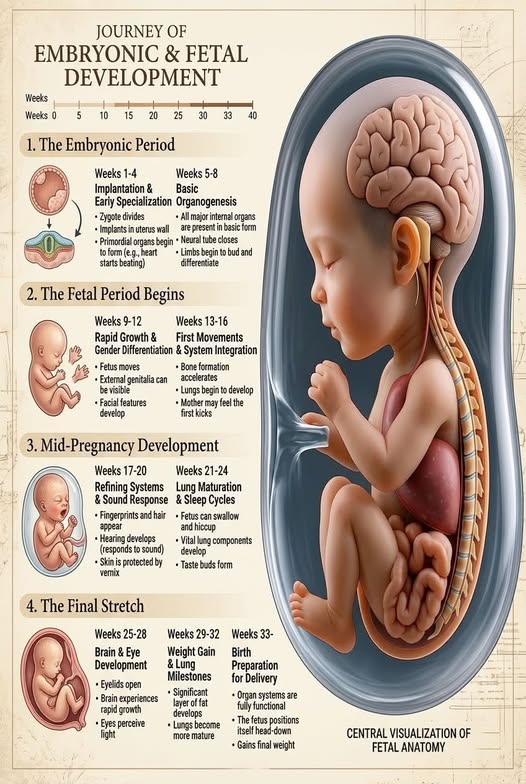
(From Fertilization to the Formation of a Baby)
Embryonic development is one of the most remarkable processes in biology—the transformation of a single fertilized cell into a complex human organism. During the first weeks after conception, billions of carefully coordinated cellular changes take place to form the foundation of the brain, heart, organs, and body systems.
🌱 Stage 1: Fertilization — The Beginning of Life
Fertilization occurs when a sperm cell joins with an egg cell, usually in the fallopian tube.
The result is a single cell called a:
Zygote
The zygote contains a complete set of genetic instructions:
🧬 23 chromosomes from the mother
🧬 23 chromosomes from the father
Together, they form the unique genetic blueprint of a new individual.
🌱 Stage 2: Cell Division Begins (Days 1–5)
The zygote begins rapidly dividing through a process called mitosis.
It becomes:
- 2 cells
- 4 cells
- 8 cells
- Many more cells
Although the number of cells increases, the embryo remains very small.
The developing group of cells eventually becomes a:
Blastocyst
🌱 Stage 3: Implantation (Around Days 6–10)
The blastocyst travels to the uterus and attaches to the uterine lining.
This process is called:
Implantation
The embryo begins receiving nutrients and oxygen through early connections that will later develop into the placenta.
🌱 Stage 4: Formation of the Three Germ Layers (Weeks 3–4)
During a process called gastrulation, the embryo forms three primary layers.
These layers develop into different parts of the body:
🧠 Ectoderm
Forms:
- Brain
- Spinal cord
- Nervous system
- Skin
❤️ Mesoderm
Forms:
- Heart
- Blood vessels
- Muscles
- Bones
- Connective tissues
🫁 Endoderm
Forms:
- Digestive system
- Respiratory system
- Internal organs
🌱 Stage 5: The Heart Begins Developing ❤️
One of the earliest organs to begin functioning is the developing heart.
During early weeks:
❤️ Heart structures form
❤️ Blood circulation begins
❤️ The cardiovascular system develops rapidly
This early system helps deliver oxygen and nutrients throughout the growing embryo.
🌱 Stage 6: Brain & Nervous System Development 🧠
The nervous system begins forming very early.
Important changes include:
- Neural tube formation
- Brain structure development
- Early nerve connections
The neural tube eventually develops into:
🧠 Brain
🧬 Spinal cord
🌱 Stage 7: Organ Formation (Weeks 4–8)
This period is called the:
Embryonic Period
Major structures begin forming:
👁️ Eyes
👂 Ears
🖐️ Arms and legs
❤️ Heart
🫁 Lungs
🦴 Skeleton
🧠 Brain regions
By the end of this stage, the basic body plan is established.
🌱 Stage 8: Transition to Fetal Development (After Week 8)
After approximately 8 weeks, the developing organism is called a:
Fetus
The focus shifts from creating basic structures to:
✅ Growth
✅ Refinement
✅ Organ maturation
🌱 How Cells Know What to Become 🧬
One of the amazing parts of development is that cells receive signals telling them what role to take.
A cell may become:
- A nerve cell
- A muscle cell
- A skin cell
- A blood cell
This process is guided by:
🧬 Genes
🧬 Chemical signals
🧬 Interactions between cells
🌱 The Role of the Placenta 🤰
The placenta is a temporary organ that supports pregnancy.
It helps:
✅ Deliver oxygen and nutrients
✅ Remove waste products
✅ Produce important hormones
✅ Support communication between mother and developing baby
🌱 Factors That Influence Embryonic Development
Healthy development depends on many factors, including:
🥗 Nutrition
💧 Hydration
😴 Rest
🩺 Prenatal healthcare
🧬 Genetics
🌎 Environmental conditions
Avoiding harmful substances such as alcohol, tobacco, and certain drugs is important during pregnancy.
Amazing Facts About Embryonic Development ✨
🌟 A single fertilized cell can develop into trillions of specialized cells.
🌟 The heart begins developing very early in pregnancy.
🌟 The brain and nervous system begin forming during the earliest weeks.
🌟 Every organ system follows a carefully timed developmental sequence.
Social Media Caption ❤️
“The journey from a single cell to a developing human is one of nature’s greatest miracles. 🧬✨ Every heartbeat, organ, and body system begins with a carefully coordinated process of growth and transformation.”
Final Description 👶✨
Embryonic development is a complex and extraordinary journey in which a single fertilized egg transforms into a developing human through carefully controlled stages of cell division, specialization, and organ formation. From the first moments after fertilization to the formation of the heart, brain, and body systems, it represents one of the most fascinating processes in human biology. 🌱🧬